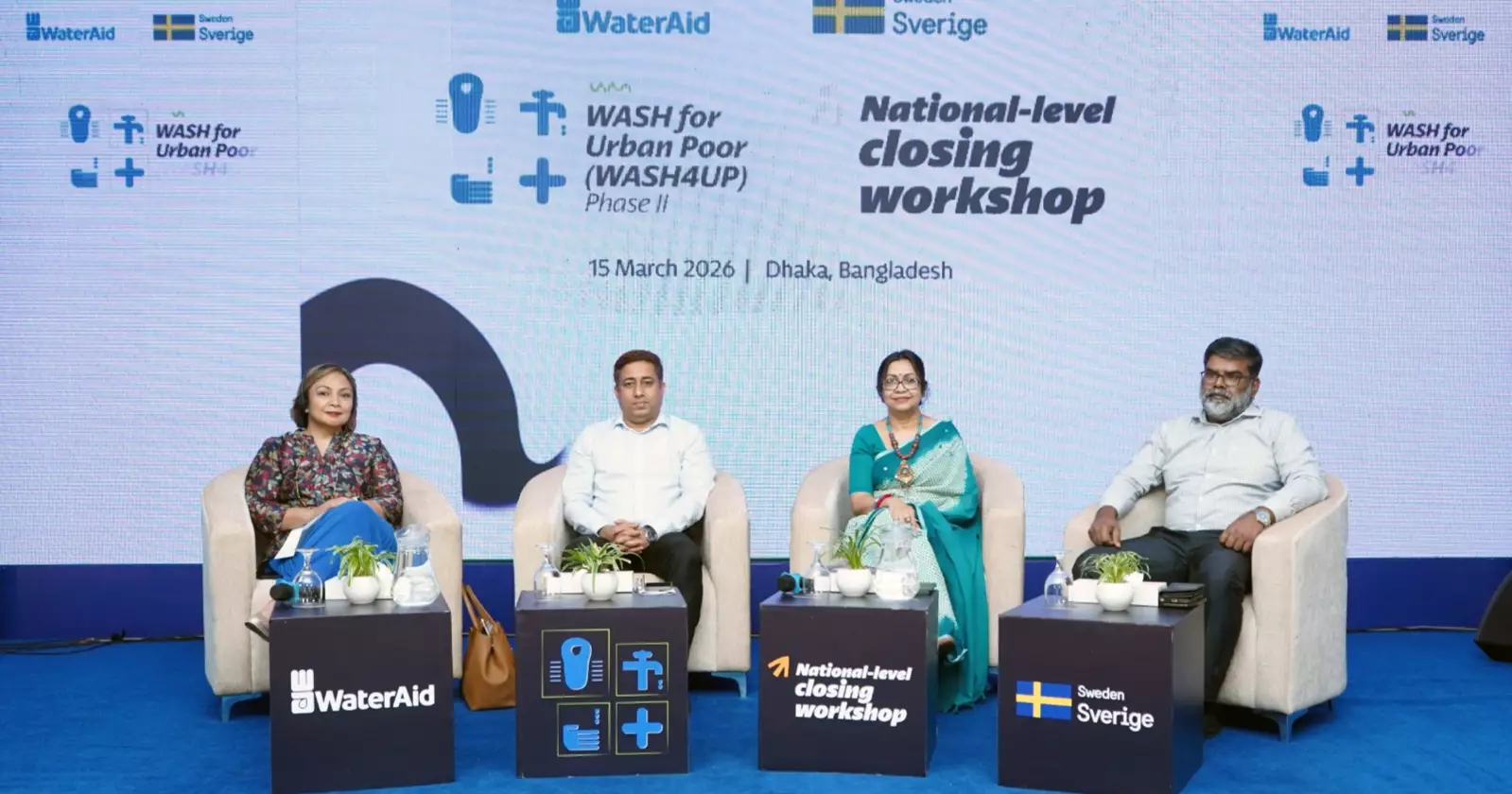
WaterAid Bangladesh, supported by the Embassy of Sweden, has hosted a national workshop to mark the completion of the ‘WASH for Urban Poor (WASH4UP) Phase II’ project, highlighting achievements, lessons and future priorities for inclusive, climate-resilient water, sanitation and hygiene services.
The workshop highlighted key achievements, lessons learned, challenges and stakeholder reflections from the project, which was implemented from April 2023 to March 2026.
It also presented baseline and endline findings and discussed priorities for sustaining and scaling inclusive, climate-resilient water, sanitation and hygiene (WASH) services for the urban poor in Bangladesh.
Speaking as the chief guest, Mohammad Saiful Islam Mazomder, Joint Secretary of the Policy Support Branch under the Local Government Division, said the issues raised at the event would be reflected in government policies and necessary steps would be taken to support their implementation.
Special guest Nayoka Martinez-Bäckström, First Secretary (Environment and Climate) and Deputy Head of Development Cooperation at the Embassy of Sweden in Dhaka, said the partnership with WaterAid extends beyond the two phases of the programme and spans nearly two decades.
She noted that globally, the collaboration focuses on ensuring accessible, quality and sustainable WASH services and emphasised that the sector is interconnected with multiple factors.
Mohammad Mamun-Ul-Hasan, Chief Social Welfare and Slum Development Officer of Dhaka North City Corporation, stressed the importance of maintaining infrastructure alongside fulfilling responsibilities towards citizens. He expressed hope that WaterAid’s initiatives would continue to expand, said a press release.
The event was chaired by Hasin Jahan, Country Director of WaterAid Bangladesh, who also delivered the vote of thanks. In her closing remarks, she said that inspired by WaterAid’s work, the Directorate of Education has taken various initiatives using its own funding to promote positive WASH behaviour among students. She also underlined the importance of coordinated research involving the Department of Public Health Engineering, WASA, city corporations and private institutions to support evidence-based decision-making.
Around 120 participants, including policymakers, government officials, donor representatives, academics, think tanks, sector experts and NGO and INGO representatives, attended the workshop.
Despite the perception that urban areas enjoy better WASH services, significant disparities persist among people living in slums and informal settlements. These communities remain highly vulnerable to waterborne diseases, poor sanitation and environmental hazards such as waterlogging and flooding.
The WASH4UP Phase II project aimed to improve environmental health and resilience among these underserved populations. It was implemented in Dhaka North and South, Chattogram and Khulna city corporations, as well as in the municipalities of Paikgacha, Sakhipur and Saidpur.